




October 23, 2026
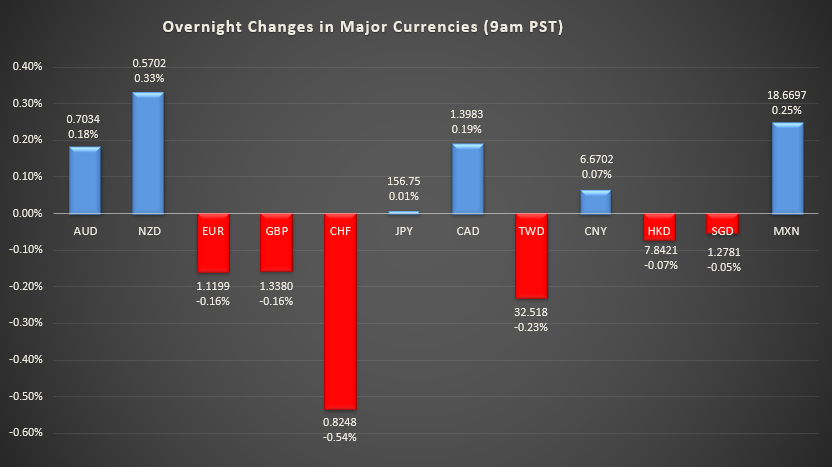
Euro traded at 1.1199 against USD at 9:00 AM PST
The euro area private sector softened to a four-month low in October as activity in France shifted back into contraction amid tightening financial conditions and rising political pressures. The composite output index fell from 53.1 in September to 51.9 in October. Both manufacturing and services sectors reported weaker growth. The manufacturing Purchasing Managers' Index (PMI) registered 52.4, down from 52.9 in the previous month. The services PMI declined from 53.0 a month ago to 51.7, also disappointing expectations of 52.6.
The French private sector slipped back into contraction after posting its first expansion in 10 months in September. Meanwhile, Germany and the other member countries continued to grow, albeit more slowly. October PMI shows that the economy remained resilient amid higher energy prices. Growth concerns seem mostly centered around France, while input costs are rising across the Eurozone again. Output and new orders both increased for the fourth month in a row in October, but at slower rates. Meanwhile, employment was broadly unchanged, rising only fractionally, amid a less positive outlook for the coming year. A stronger growth in manufacturing input costs pushed up overall input price inflation, but output prices rose at a slower pace than in September.
Germany's private sector growth softened in October, suggesting that the recovery remains fragile. The flash composite output index registered 52.8, down from an 11-month high of 53.8 in September. Nonetheless, the score signaled a solid pace of expansion by historical standards. The slowdown was broad-based by sector. The services PMI fell from 52.9 in September to 51.7 in October. The reading was seen at 52.5. Likewise, the factory PMI stood at 54.2 compared to 53.9 in September.
France's private sector activity contracted in October, marking a reversal from September's growth rebound. The flash composite output index fell from 51.1 in the previous month to a four-month low of 48.4. The services PMI posted 48.4, down from 51.2 in September. At the same time, the manufacturing PMI reached an 11-month low of 49.3 compared to 50.6 in the prior month. 10/23/2026 - 08:12:00 (RTTNews)
British Pound traded at 1.3380 against USD at 9:00 AM PST
The United Kingdom private sector activity grew the most in eight months in October, supported by the sharpest rise in new work since September 2024. The flash composite output index advanced from 52.0 in September to 53.1. The index remained above the neutral 50.0 mark for the fourth consecutive month. Faster rates of output growth were recorded in both the manufacturing and service sectors, with the former posting its strongest upturn in over two years.
The services Purchasing Managers' Index climbed from 52.1 in the previous month to an eight-month high of 53.1. At the same time, the factory PMI hit 52.8 in October, a five-month high, and went up from 51.9 in September and the forecast of 51.8. Greater demand meant that employment numbers returned to growth, which ended two years of job cuts. There was another steep rise in input prices. The rate of cost inflation was the strongest since June. Meanwhile, prices charged by private sector firms increased at a slightly slower pace.10/23/2026 - 08:58:00 (RTTNews)
Japan's private sector expanded at a solid pace in October as services activity picked up, while manufacturing growth slowed to a seven-month low. The composite output index was unchanged from September at 52.3. The private sector activity expanded for the nineteenth consecutive month, but the rate of growth was the joint-lowest since May.
Manufacturers reported the softest growth in output in seven months, while services business activity logged a great improvement. The flash manufacturing Purchasing Managers' Index (PMI) dropped from 54.1 in the previous month to 53.3. The score was seen at 54.5. Meanwhile, the services PMI rose from 51.3 a month ago to 52.0.
New order growth softened in October. Despite another increase in the amount of backlogged work, firms expanded their payrolls only marginally. Regarding prices, there was a sharp increase in average input prices, but selling price inflation eased to a four-month low. 10/23/2026 - 02:55:00 (RTTNews)
Singapore's consumer price inflation slowed marginally in September after rising to the highest level in just over two years in August. The consumer price index (CPI) climbed 2.2% year-over-year in September, following a 2.3% rise in August, which was the highest inflation rate since July 2024. MAS core inflation also moderated from 2.2% in August to 2.0% in September due to lower inflation for services and retail and other goods.
Services inflation eased from 2.0% to 1.7% due to a smaller increase in point-to-point transport service costs and a larger decline in telecommunication service prices. Similarly, retail and other goods inflation slowed from 1.8% to 1.2% as clothing prices rose at a slower pace. Private transport inflation softened from 7.5% to 7.1%, led by a more gradual increase in car prices. Meanwhile, food inflation edged higher from 2.3% to 2.4%, and electricity and gas prices grew at a steady pace of 8.7%. 10/23/2026 - 04:42:00 (RTTNews)
The unemployment rate in Taiwan increased marginally in September. The seasonally adjusted unemployment rate came in at 3.33% in September versus 3.32% in August. In the same period last year, the rate was also 3.35%. On an unadjusted basis, the jobless rate dropped from 3.41% in the previous month to 3.36%. Unemployment decreased by 6,000 from the previous month to 405,000. Meanwhile, total employment declined by 15,000 from August to 11.64 million in September. The labor force participation rate was 59.59%, down from 59.69% in the prior month. 10/23/2026 - 08:07:00 (RTTNews)
国泰银行准备的此市场最新讯息仅供参考,不构成任何形式的法律、税务或投资建议,也不应被视为对未来汇率变动或趋势的保证或担保。提供此信息时没有考虑任何接收者的特定目标、财务状况或需求。国泰银行对本市场最新讯息的准确性、完整性或充分性不做任何表述或保证。
